
Why I’m removing my ebooks from Amazon…
Content Warning: NPR article reference involving suicide.
If you use the iOS version of the Kindle App to read ebooks, you’ve likely already noticed the latest feature—the AI-powered chatbot, “Ask This Book.”
If you don’t, it’s a feature Amazon plans to integrate across all kindle devices (including the android version of the app) in early 2026.
You might be wondering, well what is “Ask This Book?”
It’s a generative AI used to answer questions a reader may have about the book they’re reading. It’ll offer answers and details about characters, the story, thematic elements, and synopses. Amazon touts it as “your expert reading assistant, instantly answering questions… without disrupting your reading flow.”
And authors, like myself, are not given the choice to opt-out.
Following the official Amazon announcement for the new feature, authors quickly discovered not having this feature in their books wasn’t an option. When questioned on the matter, an Amazon spokesperson shared, “To ensure a consistent reading experience, the feature is always on, and there is no option for authors or publishers to opt titles out.” Source: Publisher’s Lunch | Writer Beware
When I made the announcement I’ll be pulling my ebooks from Amazon on TikTok and Instagram, it blew up. (Over 300k views, 57k likes, 1.5k comments, and 6.5k shares—on Tiktok alone. IG reflected slightly lower, but still comparable metrics.) It was a terrible time for an introverted, anxious author like myself.
In the chaos, several things became clear…
Many people didn’t realize the feature was a thing. More cried about AI infiltrating our lives against our will (reflecting the same findings as this 2025 Pew study). Others didn’t see the harm it caused if it’s being used as an accessibility feature. And a nihilistic few shared their resignation. (e.g., AI is everywhere/already has your work, why bother fighting it?)
And truthfully, I get it. I understand the appeal of AI.
It makes life (and thinking) effortless. Through prompting AI, you can output hilarious memes, catch up on a book you read years ago before diving into the next installment, generate photos of lost loved ones to see what they would look like were they still around today, and whip up a professionally worded email in seconds.
But let’s be real.
AI is damning.
No matter how you look at it.
Article after article and statistic after statistic proves AI is harming us in more ways than one.
+ AI Data Centers Poison Marginalized Communities | UC Berkeley Law 2022
+ “I can’t drink the water” —life next to a US Data Centre | BBC News 2025
+ Theft is not fair use | Stanford University Journalistic Press, Medium 2025
+ AI can already replace 11.7% of the US workforce | MIT Research 2025
+ Is AI dulling our minds? | Harvard Gazette, 2025
+ Teen sons died by suicide, AI involved | NPR, 2025
And these are just a few recent articles or studies, all within the last five years, detailing how AI negatively impacts and will continue to negatively impact our lives.
Many of these Language Learning Models (LLMs) are trained on the stolen works of authors, artists, and other creatives. There are several ongoing lawsuits involving companies such as OpenAI, Meta, and Anthropic in which copyright is being challenged. These companies used pirated copies of copyrighted works (and in many cases knowingly so) to train their LLMs.
Amazon adding a generative AI feature to all books opened on their devices or in their Kindle App is a huge slap in the face to all authors.
Now, Amazon sits on one of the largest, if not the largest, databases for literary works with over 44 million titles. And with an estimated $28 billion in revenue per year, it can safely be said Amazon has quite the foothold on the book market.
Both indie and traditionally published authors offer their ebooks through their platform. And Amazon is often the easiest and most price conscious means for an indie author to get their work into the world. (It’s one of the reasons I chose to self-publish with Amazon.)
In the race to the bottom with AI integration into everything, why wouldn’t Bezos want to capitalize on the wealth of data at his fingertips?
He would veneer it under the guise of accessibility.
Accessibility shouldn’t come at the cost of theft of copyrighted works. Amazon acts like bookish communities don’t exist, or that the average reader isn’t capable of digesting the books they read without help.
Nor should I simply allow the theft of my works when I am positioned to make a clear, definitive stance.
I have never and will never endorse generative AI use.
Authors and other creatives have been persistently stomped upon. The arts are the first programs to be cut from schools when funding dries up. We’re expected to suffer for our art—not make a living.
We’re already seeing the mass influx of AI generated artwork, music, movies, and books. Each new piece of generative AI slop added to the internet is a bastardization of talent stolen by genuinely talented humans.
Why are we leaving the pieces of art we seek
to feel something to an invention incapable of feeling?
Creatives bear pieces of their souls when they create—no generative AI will ever capable of doing the same. And I certainly do not want my work to be scraped for training so that some LLM can produce a weakly echoed voice, factually incorrect information pertaining to the source material, or similar themes/ideas found in my work.
Now, I’m not saying I’m some creative genius desperately trying to protect my intellectual property (IP).
But it is mine and IP laws already exist. Furthermore, I am a human who poured two decades of being too afraid to write again into my debut novel.
I realize many authors aren’t going to be in the same financial position to pull their works. The Kindle Unlimited (KU) program provides a fair (if not their entire) income for established authors.
This doesn’t mean those authors support AI.
It means they have to make difficult decisions and seeing as we’re all bound to late stage capitalism, it’s not always the decision in their heart.
A large number of readers are going to be stuck in the Kindle ecosystem—myself included. I own a Kindle Scribe and it holds my entire library of ebooks. Purchasing a comparable ereader isn’t cheap and neither is migrating a large library of ebooks.
I am lucky enough to be able to choose this battle and pull my ebooks. The royalties I earn each month aren’t enough to survive on, but I am earning. (In fact, all costs considered, I’m still heavily in the red for both my debut and sequel.) And yes, pulling my ebooks from Amazon is going to be felt financially. It will also greatly impact my discoverability—the KU program enables readers in discovering authors and genres they wouldn’t otherwise consider.
Even so, after December 31st, 2025 no ebook versions of my work will be available for purchase or through KU on the Amazon marketplace. I may not be able to entirely stop AI from scraping what I’ve created, but I can sure as hell stand against it to my fullest capacity.
What does this mean for
The Fated Celestials Trilogy
going forward?
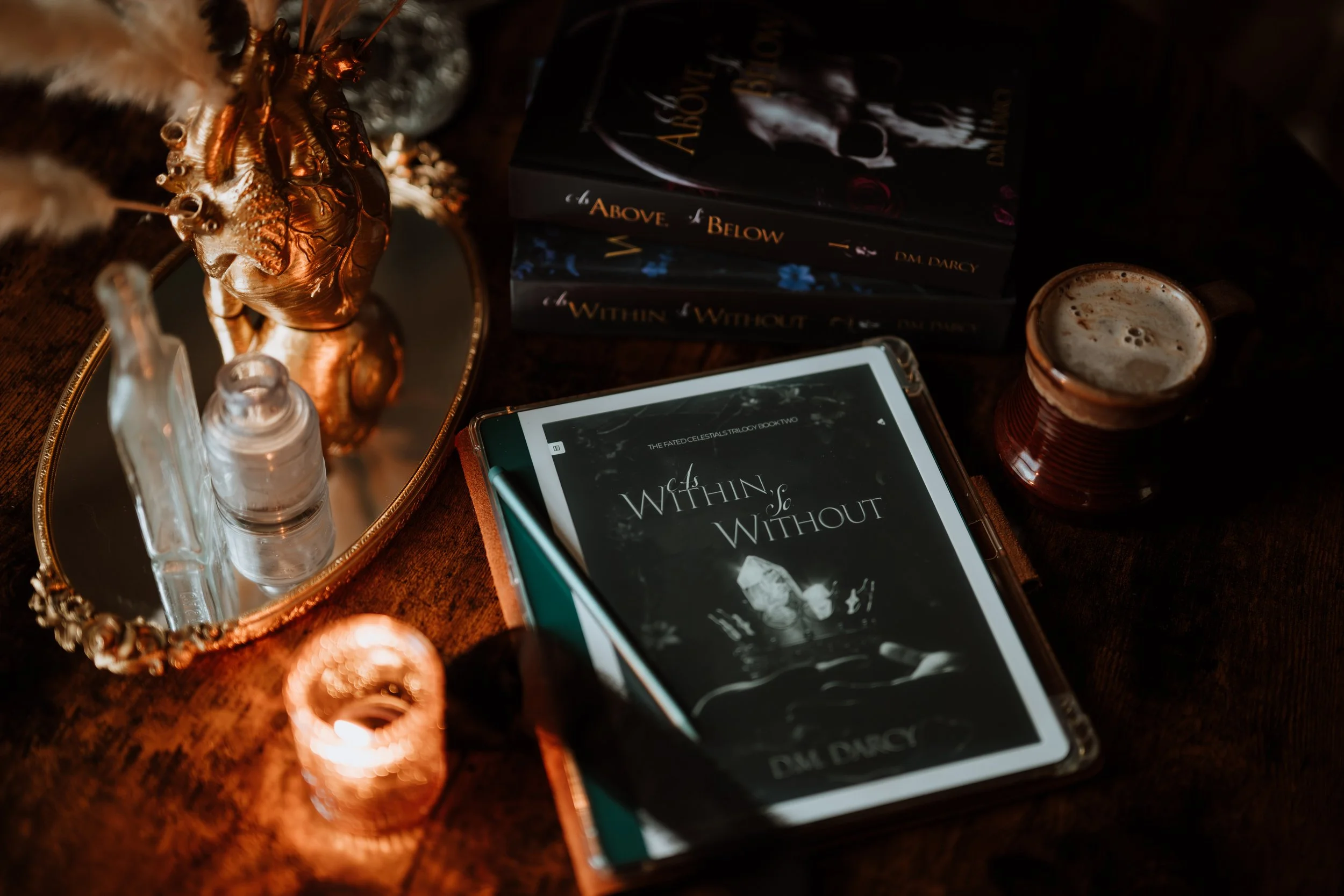
Because my available ebooks (As Above, So Below and As Within, So Without) are currently enrolled in KU, I am bound by Amazon’s exclusivity clause. In case you weren’t aware, small indie authors like myself must agree to a 90-day exclusivity clause in order to participate in the Kindle Unlimited program. During enrollment, I cannot legally distribute my ebooks anywhere else.
And wouldn’t you know it, Amazon made this feature announcement on December 11th, 2025. My KU renewal date (which automatically renews unless you opt-out beforehand) was December 9th (As Above, So Below) and December 10th (As Within, So Without). Thus, even once they’re removed, I cannot immediately offer them elsewhere.
Both the print and audiobook versions will remain available. And while I realize this can be percieved as a blow to the parts of the reading community, know that I will be offering the ebook version once the exclusionary period ends. Whether that be solely on my website or through a different platform such as Kobo, Barnes and Noble, etc., remains to be seen.
I’ve a bit of time to research options.
